|
Just a snapshot of an endless chaotic process
The Flap of a Butterfly's Wings
Music for advanced meditation
The flap of a butterfly’s wings can change the course of the world
- the credo of chaos theory, so to speak.
But let’s start from the beginning:
Ever since the computing power of available computers became sufficient (around the mid-1980s), I have been engaged in simulating physical processes that - in the broadest sense -could be used to generate sound.
“Physical models” is what they were called back then. (Although this term was also used to describe algorithms that were merely employed pragmatically as substitutes for known instruments and sounds).
One of the strangest among them was a gravitational model: a few mass points in space, with initial conditions (mass, position, velocity), that are released and, due to gravitational forces, begin to follow their paths unwaveringly.
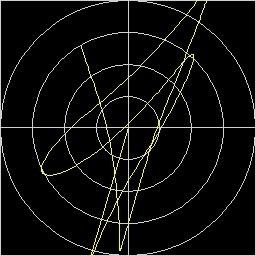
You need at least three points to do this. In mathematics, this is known as the “three-body problem” because there is supposedly no formula that can be used to predict the positions of the bodies. But it can be simulated numerically and - with the right settings - also output as a sound process.
No problem.
The result is both fascinating and unsettling! Restless, seemingly random developments that suddenly settle into pseudo-stable states, only to change or dissolve just as suddenly and unpredictably.
Attempting to apply traditional musical criteria here is futile. Even the slightest change in the initial conditions has unforeseeable, complex effects on the course of the whole!—just like the flap of a butterfly’s wings.
G.R. 2026
 |
1 CD in cart sleeve |
|
 |
Günther Rabl
NO PROBLEM
53min stereo, Heumühle, Rappottenstein 2025
Just a snapshot of an endless chaotic process
The Flap of a Butterfly's Wings
Music for advanced meditation
Der Flügelschlag eines Schmetterlings kann den Lauf der Welt verändern -
das Credo der Chaostheorie, sozusagen.
Aber von vorne:
Seit die Rechenleistung der verfügbaren Computer groß genug war (so ab Mitte der 1980er), beschäftigte ich mich mit der Simulation von physikalischen Vorgängen, die - im weitesten Sinn - zur Klangerzeugung verwendet werden konnten.
"Physikalische Modelle", nannte man das damals. (Obwohl unter diesem Begriff auch Algorithmen propagiert wurden, die lediglich pragmatisch als Ersatz für bekannte Instrumente und Klänge eingesetzt wurden).
Eines der seltsamsten darunter war ein Gravitationsmodell: Ein paar Massepunkte im Raum, mit Anfangsbedingungen (Masse, Lage, Geschwindikeit), die losgelassen werden und aufgrund von Gravitationskräften beginnen, unbeirrt ihre Bahnen zu ziehen. Etwa so:
Drei Punkte braucht man mindestens dazu. In der Mathematik kennt man das daher als das "Dreikörperproblem", weil es angeblich keine Formel gibt, mit der man die Position der Körper vorherbestimmen kann. Aber numerisch simulieren lässt sich das und - bei geeigneten Einstellungen - auch als Klangprozess ausgeben.
No Problem.
Das Ergebnis ist faszinierend und verstörend zugleich ! Unruhige, wie zufällige Entwicklungen, die plötzlich in pseudo-stabile Zustände geraten, sich aber ebenso plötzlich und unvorhersehbar verändern oder auflösen.
Hier traditionelle musikalische Kriterien anwenden zu wollen, ist aussichtslos. Jede noch so kleine Veränderung in den Anfangsbedingungen hat unabsehbare, komplexe Auswirkungen auf den Verlauf des Ganzen ! - Eben der Flügelschlag eines Schmetterlings.
G.R. 2026
|
1 CD in cart sleeve |
|
 |

